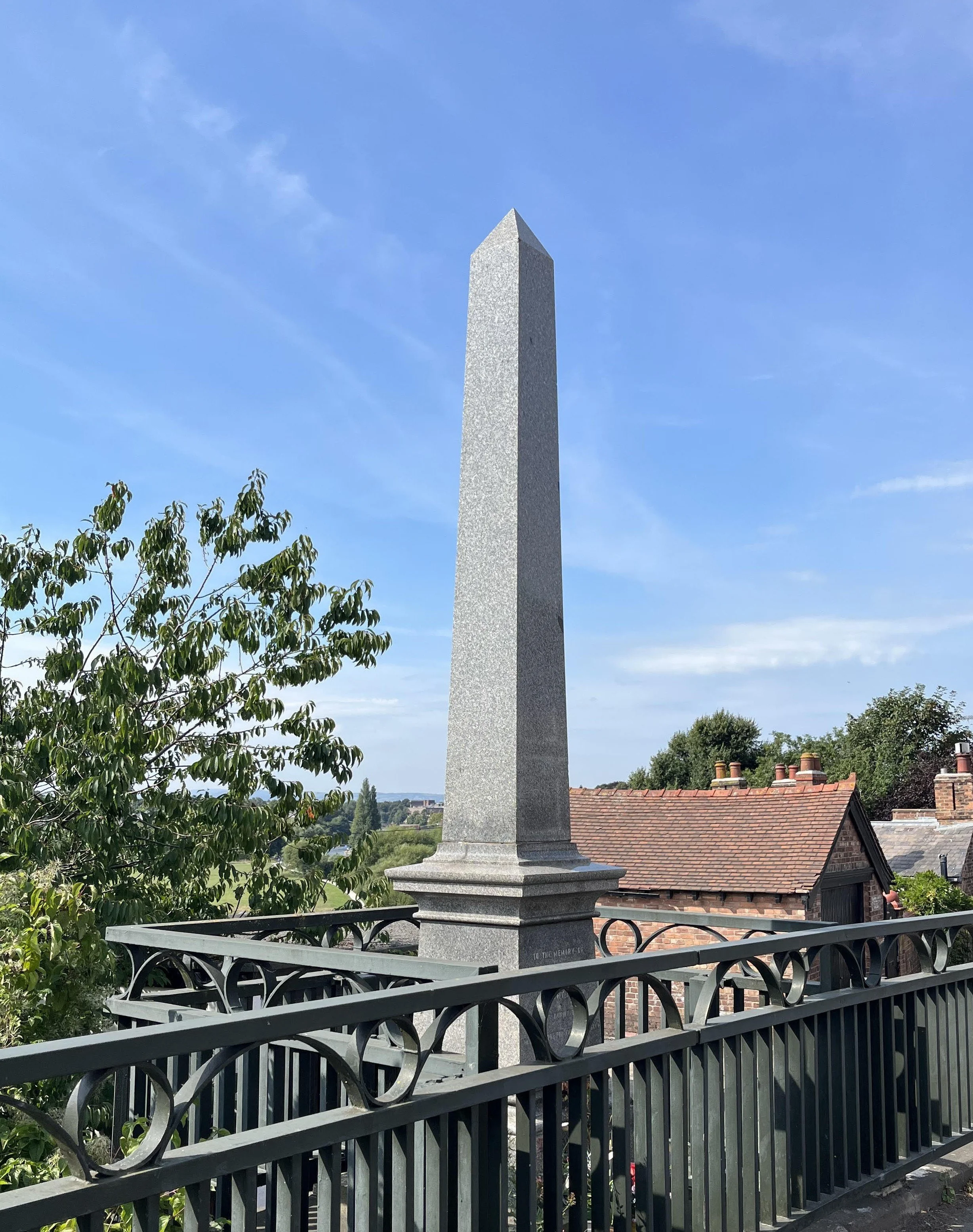
The memorial to George Marsh on Boughton
The second most read book in England in the late 17th Century – after the Bible – was Foxe’s Book of Martyrs. This described, often in gruesome detail, the suffering and deaths of some 300 Protestant martyrs executed during the reign of the Catholic Queen Mary I. A chapter was set aside for George Marsh, who was an in-mate of Northgate Gaol, tried by a bishop in Chester’s Consistory Court and suffered a terrible fate at Chester’s execution ground in Boughton.
If you walk out of the centre of Chester via the Eastgate and along Foregate Street and then Boughton for about a kilometre, you come to a gap in a line of buildings on the right hand side which offers a fine view over the River Dee. Unfortunately this lovely view was also the last thing on earth seen by criminals found guilty of capital offences, as the open ground marks the location of Chester’s historic execution ground – known as Gallows Hill.
A little further along the road, close to a bus stop, a granite obelisk is inscribed with the following dedication:
TO THE MEMORY OF
GEORGE MARSH
MARTYR
WHO WAS BURNT TO DEATH
NEAR THIS SPOT FOR THE TRUTH’S SAKE
APRIL 24TH 1555
With his own chapter in Foxe’s Book of Martyrs, which was the second most read book in Elizabethan England after the Bible, George Marsh was the most famous person to be executed in this location.
George Marsh, from Deane near Bolton, preached the Protestant faith in defiance of Queen Mary I's Catholic regime and was arrested and imprisoned for heresy. Initially held at Lancaster Gaol, he spent nearly a year reading the Bible and praying with townsfolk who gathered outside his cell.
His steadfast refusal to recant his Protestant faith drew the attention of George Cotes, the Bishop of Chester, who organised his transfer to Chester’s notorious prison at the Northgate.
He was then brought before the consistory court of Chester, presided over by the bishop himself, in the Lady Chapel of Chester Cathedral. The bishop and the chancellor of the court gave Marsh several opportunities to recant, but he refused. Having lost patience, Bishop Cotes read out Marsh’s sentence to be burnt at the stake as a heretic, and, according to John Foxe’s Book of Martyrs, he added, "Now will I no more pray for thee, than I will for a dog."
Marsh was handed over to the sheriffs of Chester and imprisoned once more at Northgate Gaol, awaiting his execution. Some of his local supporters, probably under cover of darkness to avoid being observed by the authorities, called to him in his cell via an air hole and dropped coins to him so he could buy something to eat from his gaolers.
On April 24, 1555, Marsh was led in chains to Gallows Hill. He was tied to a stake with a barrel of tar suspended above him and wood placed below, so that molten tar dripped onto his head and face, as he was consumed by flames from below.
According to John Foxe’s Book of Martyrs, Marsh’s death was slow and agonizing as “the fire was unskilfully made, and that the wind did drive the same to and fro, he suffered great extremity in his death, which notwithstanding he abode very patiently”. Foxe described his final moments as follows: “…when he had been a long time tormented in the fire without moving, having his flesh so broiled and puffed up” so that the onlookers assumed he was dead, “suddenly he spread abroad his arms, saying, "Father of heaven, have mercy upon me!" and so yielded his spirit into the hands of the Lord.”